Last update: January 2026
For over twenty years, this beloved cocktail has been Hemingway It holds the top spot on the French bar scene. Found on the menus of many bars. This cocktail requires a certain level of precision in preparation. Unfortunately, many bartenders often don't have enough time to prepare it properly. Today, we'll take the time to rediscover the original Cuban recipe.
The basics of a successful Mojito
The success of the Mojito lies in meticulous attention to detail. Consider the recommendation from the world-renowned Robert Hess: 'Never ask for a Mojito from a busy bartender, the Mojito is a complicated cocktail, which takes time ».
The importance of using fresh, high-quality ingredients!
For a first-class mojito, keep the ingredients cold until the very last moment, No Pulco, please! Mint is a crucial element, as is ice; either because you don't have enough or because these ingredients are of poor quality (and the CM readers know not to joke around with the ice (in French)), leave your Mojito cravings for next week's evening!
Muddling technique to avoid bitterness
Crushing the mint allows the essential oils to be extracted, which contribute its aroma to the cocktail. This technique is regularly used when preparing cocktails with aromatic herbs or fruit peels. If you press too hard, you'll release the more bitter essences—so do it gently!
The secret of sugar
Powdered sugar helps extract essential oils more easily; by crushing mint gently, we avoid releasing its bitterness (see above).
Sugar dissolves most easily in water, but in the presence of ice and alcohol it becomes very difficult to dissolve. Therefore, you should first dissolve the sugar in a small amount of water, and only crush the mint leaves. Then add the other ingredients.
Here is the single-serving recipe to explain the details of a Mojito. The 1L recipe appears further down the article.
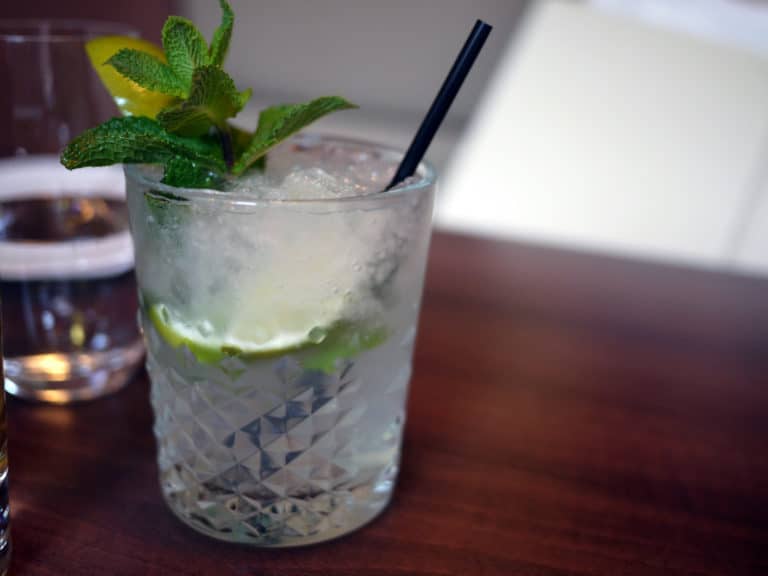
Mojito: the original Cuban recipe

Ingredients
- 5 cl Cuban-style rum Havana Club
- 2 cl lime juice
- 2 tsp white sugar
- 6-8 leaves fresh mint
- 3-4 cl sparkling water
Equipment
- highball or tumbler glass
- muddler
Instructions
- Put the mint leaves in the bottom of the glass.
- Add the sugar. Its abrasive texture helps extract the mint flavour without bitterness.
- Add a tiny amount of sparkling water. Remember Mojitos with a thick layer of sugar at the bottom? The bartender probably overlooked this initial addition of water, which helps dissolve the sugar.
- Gently muddle the mixture — gently! Too much pressure makes the mint bitter and leaves pieces between your teeth. The aim is to extract the mint oils, dissolve the sugar and start combining the mixture.
- Add the rum to the glass.
- Juice the lime, measure the juice and add it to the glass.
- Stir a few times with a spoon.
- Add lime wedges to the glass.
- Fill the glass ¾ full with crushed ice.
- Move the spoon up and down so the mint and lime wedges are evenly distributed.
- Top up with a splash of sparkling water.
- Garnish the glass with a small bunch of mint.
- Add a straw and serve.
Video
Mojitos are good, but they're even better when shared. Following the success of my previous article on the Mojito, I gave in to the siren call of popular demand, and I'm now sharing a recipe adapted for making a 1-liter giant Mojito. For more content like this, see our YouTube channel !
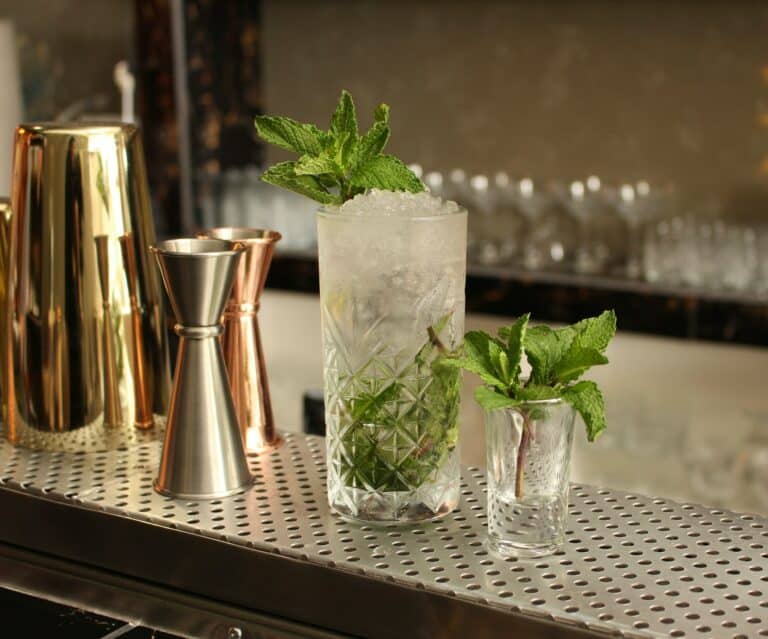
Giant 1 L Mojito
Ingredients
- 1 bottles Cuban-style rum Havana Club
- 12-15 limes (8-9 for juice, 4-5 for garnish)
- 1 bunches mint
- 1 kg white sugar (plain white sugar, not brown sugar or demerara)
- 1 bottle sparkling water
- 1 kg crushed ice (in French)
Equipment
- Large mixing bowl
- muddler
Instructions
Before the guests arrive
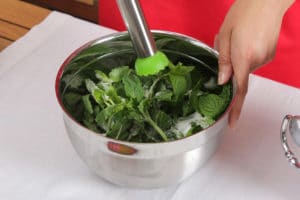
- Take half the bunch of mint. Wash it if needed, then remove the leaves one by one.
- Add six tablespoons of granulated sugar.
- Use your lever citrus juicer to squeeze the 8 limes reserved for juice.
- Pour the juice into the main container.
- Gently press the mint leaves with a muddler. We want to release their flavour, not turn them into pesto!
- Add ½ litre of Cuban rum. This is roughly ¾ of a 70 cl bottle.
- Stir gently and refrigerate, ideally for at least 1h.
During the evening
- Put mint leaves and a few wedges of the unjuiced limes into each glass. Fill the glass ¾ full with crushed ice.
- Pour 7-8 cl of the base mixture into the glass.
- Top up with sparkling water.
- Gently stir with a bar spoon to distribute the ingredients attractively.
- Add more crushed ice if needed: the glass should be filled to the rim or slightly above it.
- Garnish with a lime wheel or a sprig of mint.
Notes
The history of the classic Mojito
Know that a mojito can have various interpretations. Just like the Caipirinha (in French) Or the Mint Julep, it's a popular cocktail with no known inventor or precise place of origin. Indeed, Cubans, to soften the attack of rum and make it easier to enjoy at any time of day, used accessible local ingredients: sugar, lime, and mint (specifically, hierbabuena). The Mojito emerged around 1930 in various forms and evolved alongside Cuban society. Its popularity spread thanks to Hemingway's discovery of a local grocer who had perfected the recipe.
Because of this heterogeneous origin, it's hard to define the original recipeKnow that in Cuba, at the Havana temple of Mojitos, which is the Bodeguita del Medio, the Mojito is made with whole ice.
Yes, if you want a salad, but for a cocktail, 10 properly muddled leaves are better.
It was definitely Angostura bitters, a member of the bitters family. We sometimes add two or three 'dashes' to a Mojito to brighten it and cut through excess sweetness.
A traditional (also known as industrial) light rum, Cuban-style for authenticity, though some Puerto Rican rums work very well too. The only brand readily available in France is Havana Club.
Old rum tends to have a more intense character and warmer notes, which is not always compatible with the light and refreshing nature of a Mojito. But if you like your Mojito that way, then we won't judge you at CocktailMolotov (though we might, just a little, and silently…)
Because crushing the segments with a mortar won't release enough juice, and furthermore you'll end up with small lime segments that won't look appealing. It's also harder to measure what you're doing.
But there's still a small advantage—this releases the essential oils from the lime peel.
White sugar! The candied sugar is known only in France.
The glass-pulverized version is the one most commonly served in France (probably worldwide). It refreshes your cocktail the most. But know that in Havana, you might be served a version with large ice cubes and a longer, more carbonated water addition.
In Cuba we use the yerba buena (or hierbabuena), whose technical name is Mentha nemorosa. I've never seen the type of mint indicated at the supermarket, but if you buy it from a nursery, I imagine you'll be able to get that information.
You can now find Mojito mint, also called Hemingway mint, although I am not sure it is the same plant.
Seriously? Are you that technically detailed when making your Mojito? Honestly, at that level, I can't help you anymore. Buy three different brands or get a Sodastream and test it yourself in a double-blind experiment!
This technique, called herb smashing Releases the essential oils trapped in the plant.