AI-generated illustration.
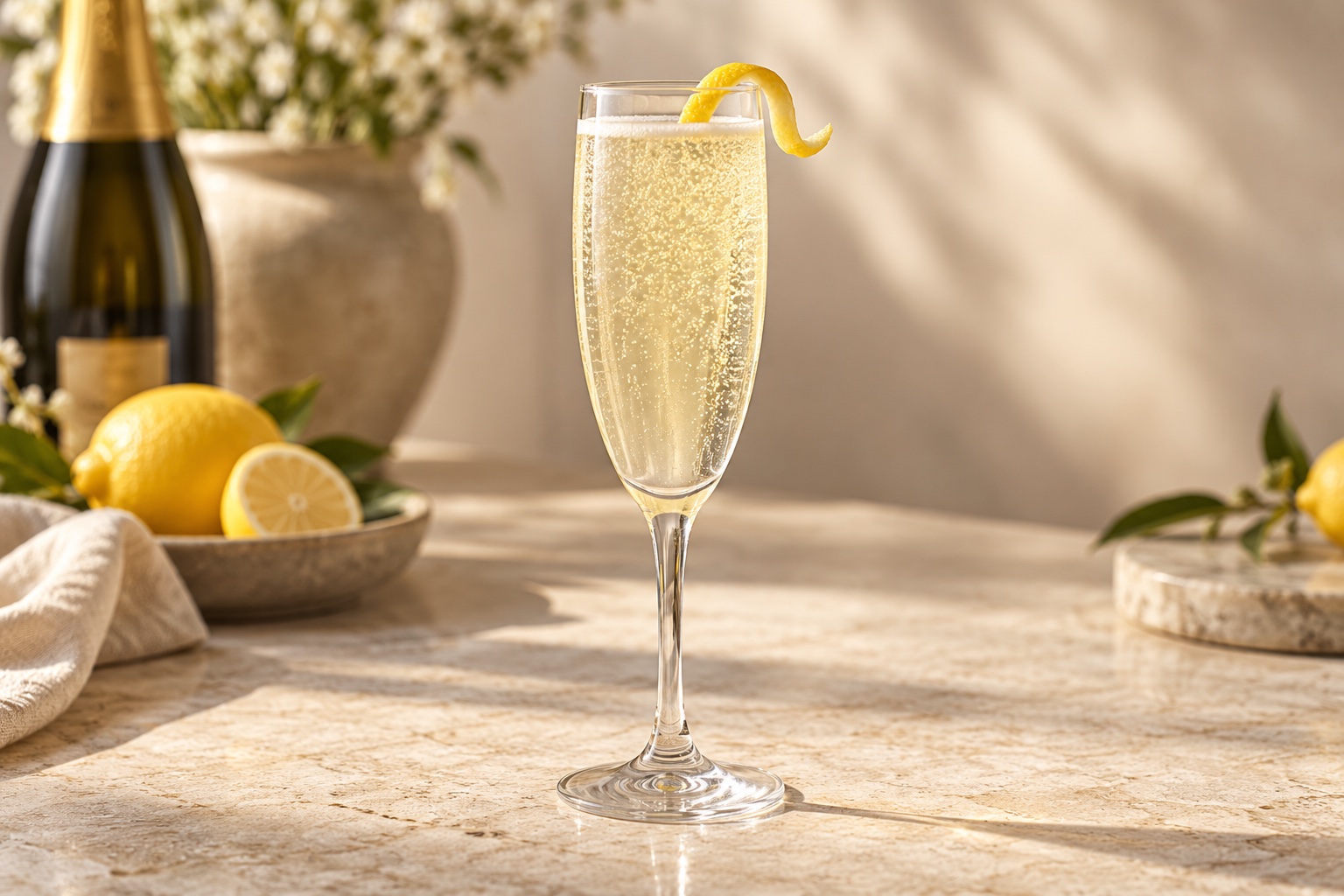
A French 75 is gin, lemon, a little sugar and Champagne. Think of a Tom Collins (in French) with Champagne in place of soda water. That sounds simple enough. But the wine brings its own acidity and sugar, so the bottle you open will affect how much syrup the drink needs.
Where did the French 75 come from?
The number refers to the French 75 mm field gun used during the First World War. The name endured, but the recipe changed. A formula published in 1915 as the “Soixante-Quinze” combined gin, apple brandy, grenadine and lemon: it contained no Champagne. Further versions appeared during the 1920s before the combination we know today came into print.
In 1922, Robert Vermeire published a “75” made with gin, Calvados, lemon and grenadine. A 1926 recipe by Harry MacElhone kept the gin and Calvados but replaced the lemon, among other changes, with absinthe. In other words, the name existed before the Champagne recipe we serve today.
Gin, lemon, sugar and bubbles were already coming together in the Collins long before the French 75. In Imbibe!, David Wondrich reproduces a John Collins published in 1869, made with soda water. Champagne plays a similar role in our recipe while adding the flavour of wine. The comparison helps explain the drink; it does not prove that its creator started with a Collins.
The Collins cited by Wondrich uses Old Tom gin, which is sweeter than London Dry. It is a tall drink served over ice, with soda water added at serving time. That detail helps explain our choice of gin: replacing both a lightly sweetened gin and soda water with London Dry and brut Champagne changes the sweetness, acidity and flavour. Keeping the basic idea does not mean copying the old proportions.
In the 1927 American book Here’s How!, the French 75 already contains gin, lemon, sugar and Champagne. It is served in a tall glass with ice. The Savoy Cocktail Book included a drink from the same family in 1930, helping it reach a wider audience. The Champagne flute familiar today is therefore only one way to serve it. These books show how the recipe changed, but they do not identify its creator with certainty. Difford’s Guide’s timeline and the Oxford Companion to Spirits & Cocktails help separate those stages.
The 1927 book itself compares the drink with a Tom Collins: replace Champagne with soda water and you have that cocktail again. The comparison is useful, but you cannot measure the sugar as you would for a Collins: Champagne is a wine as well as a source of bubbles. Two French 75s made with the same gin can therefore taste quite different when different bottles are used.
The recipe for one drink
Preparation: 4 minutes. Equipment: shaker, jigger, citrus press, strainer and Champagne flute or small wine glass.
Ingredients
- 3 cl London Dry gin
- 1.5 cl fresh lemon juice
- 1 cl simple syrup made with equal weights of water and sugar
- 6 cl well-chilled brut Champagne
- Ice cubes for the shaker
- A small lemon twist, optional
Method
- Chill the serving glass.
- Pour the gin, lemon juice and syrup into the shaker.
- Add ice and shake for about 10 seconds.
- Strain into the glass, without ice.
- Pour in the Champagne gently, in two stages if the foam rises quickly.
- Stir with one gentle movement of the spoon. If you like, express a small lemon twist over the drink.
Why these proportions?
The IBA recipe uses the same amounts of gin, lemon and Champagne, but 1.5 cl of syrup. I suggest starting with 1 cl. The lemon already brings clear acidity, while the Champagne has its own sugar level. Adding sweetness is easier than fixing a drink that is too sweet. If the result seems too sharp, add a few more drops of syrup to the next glass.
London Dry gin provides a clean base with a recognisable juniper note. A strongly flavoured gin can work too, although its botanicals will compete more with the wine. Squeeze the lemon when you make the drink; juice kept in the fridge for a long time loses its freshness. For the syrup, equal parts water and sugar by weight give you a repeatable measure.
To adjust the recipe, change one ingredient at a time. If the drink tastes too sharp, raise the syrup slightly in the next one; if sugar hides the wine, use less. If gin dominates, first check that you measured the Champagne and shook the base properly with ice. Adding more wine makes a longer drink, which you may enjoy, but it changes the balance. Measure each trial with a jigger so you know what actually changed.
Time in the shaker matters too. Shake too briefly and the base remains warm and under-diluted; shake for too long and it weakens before the Champagne arrives. The 10 seconds in the method are a starting point with firm ice cubes, not a strict timer. At serving, the drink should be cold, with a clear lemon note that does not overwhelm the wine.
Which Champagne should you choose?
A brut that you enjoy on its own is enough. The Comité Champagne defines extra-brut as 0 to 6 g of sugar per litre and brut as less than 12 g/L. These labels help you adjust the syrup: with a very dry extra-brut, taste the first drink before cutting the sugar; with a rounder wine, the suggested amount may already be enough. Avoid demi-sec for this recipe unless you reduce the syrup substantially.
The Champagne need not be prestigious, but it should still have flavour and bubbles. A brut crémant makes a less expensive variation; call it a crémant version. Prosecco will give a different character and, depending on the bottle, may taste sweeter. In either case, adjust the sugar to the wine you are actually pouring.
“Brut” tells you about the wine’s sugar level, not everything about how it tastes. Two bruts can differ in acidity, maturity and aroma. Taste a sip from the bottle before making the cocktail: if the wine seems very sharp, keep the suggested syrup; if it already seems soft, start with a little less.
Flute or tall glass?
The ice-free flute is the serve used here. It suits a small, cold drink and shows off the bubbles. A small tulip-shaped wine glass gives the aromas more room; the Comité Champagne also recommends that shape for tasting the wine. Chill either glass before you start.
If you prefer the longer drink described in books from the 1920s and 1930s, serve the mixture in a Collins glass filled with ice and top with Champagne. The ice will continue to dilute it, producing a longer, less concentrated drink than the flute version. Both serves have a history; choose the one you would like to drink.
The details that make a difference
Chill the Champagne to around 8–10°C, the range recommended by the Comité Champagne. Shake only the gin, lemon and syrup: the shaker chills and dilutes that base. Add the Champagne after straining. Shaking it would drive off bubbles and increase pressure inside the shaker.
Pour the wine slowly, then give the drink a single gentle stir to bring it together. Prolonged stirring loses foam. The twist is optional: it adds lemon aroma, while the IBA recipe calls for no garnish. If you are making several drinks, measure the gin, lemon and syrup base in advance, but shake each portion with ice and add Champagne immediately before serving.
If the flute fills mostly with foam, pause briefly after the first pour and then top it up. A fine strainer, used after the shaker strainer, catches small pieces of ice and lemon pulp; it makes a clearer drink but is not essential. Avoid squeezing a large twist into the liquid, too: a little lemon oil expressed over the glass is enough.
Making several French 75s
For six drinks using these proportions, measure 18 cl gin, 9 cl lemon juice, 6 cl syrup and 36 cl Champagne. You can measure the three still ingredients in advance and keep them chilled during service. Divide that base into six equal portions, shake each one with ice, strain, and add 6 cl Champagne to each glass.
Do not add the Champagne to a pitcher ahead of time: it will lose its bubbles while it waits, and the last guest will not get the same drink as the first. If your shaker is small, work one glass at a time. You can also chill the glasses, squeeze the lemons and put the Champagne within reach beforehand; the final assembly is quick.
What about the cognac version?
Yes, you can make a French 75 with cognac too. The Oxford Companion describes the version served at Arnaud’s in New Orleans. To try a simple variation at home, replace the 3 cl of gin with 3 cl of cognac, then adjust the syrup after your first glass: the spirit changes the drink’s flavour balance even when the other measures stay the same.
The cognac version is well documented in cocktail writing, including David Embury’s account from 1948. That comes after the gin-and-Champagne recipe published in 1927, so it does not establish cognac as the French 75’s sole original base. Arnaud’s also uses its own proportions. The simple swap suggested here lets you compare the two spirits with the other measures held steady; it does not reproduce their house recipe.
Have an open bottle and want to make something else with it? The Airmail (in French) combines rum and honey; the Old Cuban (in French) adds mint.