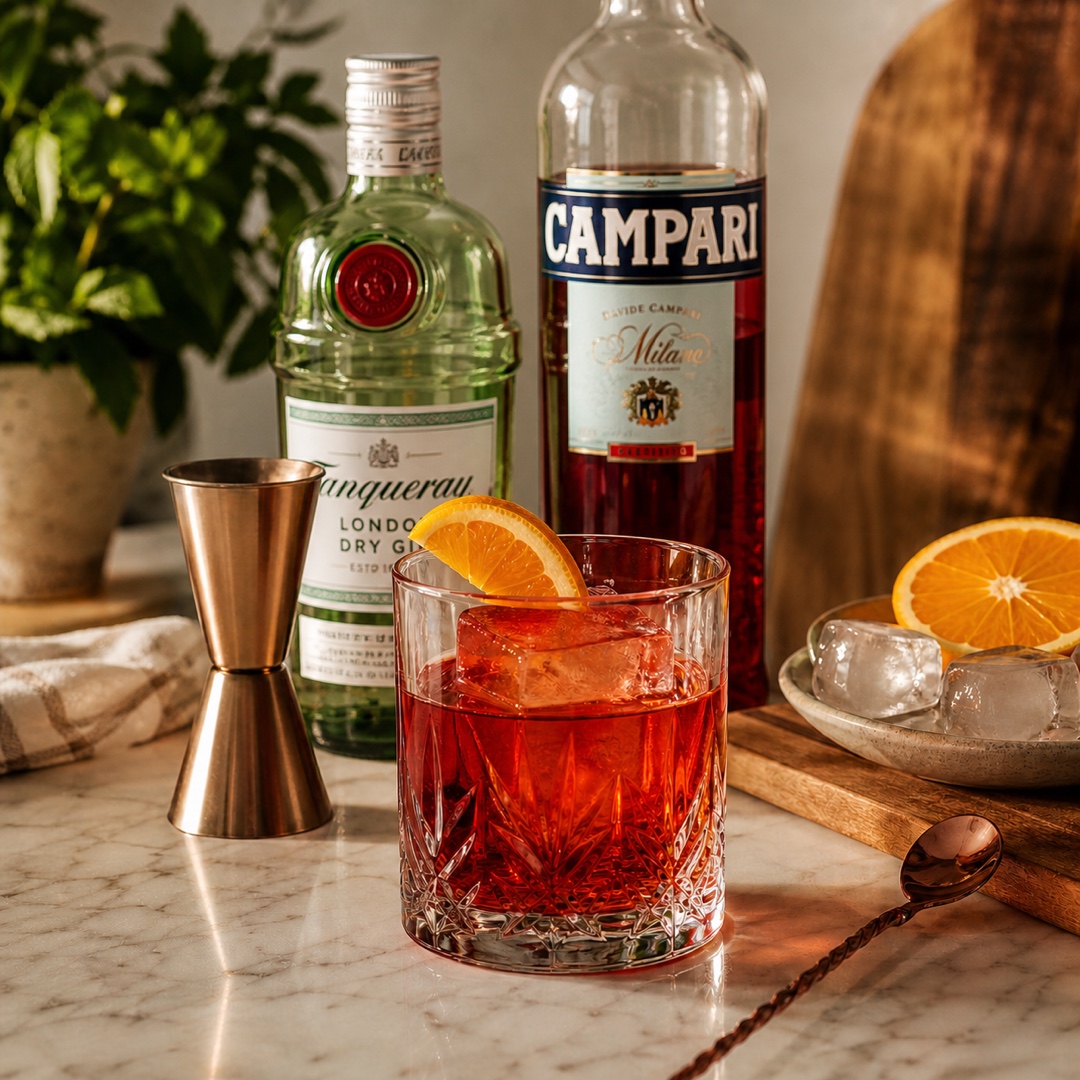

The Negroni is a cocktail with an extremely simple recipe. It consists of just three ingredients, all iconic and available in any supermarket. Despite its apparent simplicity, the Negroni is a cocktail with great depth and aromatic complexity: change the vermouth (in French) or gin, and you discover a new cocktail. It's common enough to not seem pretentious when ordered, and complex enough to satisfy all mixology curiosities. And even if you eventually grow tired of it, there exists a infinite variations on this theme (in French)But where does it come from?
The Count Negroni, myth or reality?
I was certain that the famous Count Negroni was just an urban legend. Creating a character named after an object or invention is a common trick to embellish a story. In fact, that's exactly the kind of thing you learn to spot when studying cocktail history. And well, I was wrong — this Count actually existed, which I discovered during my research, particularly in the Oxford Companion to Spirits and Cocktails.
We've also found a letter in which he speaks of ordering this cocktail at Café Casoni in Florence, and which would nothing more than a Americano (in French) Bitter with gin. The Negroni's creation therefore dates back before 1920.
But let's rewind a bit. At the beginning was the verb… not that far off, really. Let's stop at Campari-vermouth, also known as Milano-Torino, or Mi-To for short (not to be confused with the myth). The pair works very well, but it still lacks a third ingredient to solidify its stability. And so the Milano-Torino naturally evolved into the Americano by adding carbonated water. This structure itself very close to the spritz (in French)An Americano is perfect in the summer to refresh, the blend of sweetness, bitterness, and the fizz of carbonated water, and almost unbeatable for this purpose. But in other circumstances, you might need something a bit sharper. And that's how the idea of replacing carbonated water with gin arises! I wasn't there that night, but it's probably what happened between the bartender and the count.
However, it wasn't until 1947 that a written recipe appeared. We do know, though, that in the meantime, a mix of gin, Campari, and vermouth had continued to be served, especially in France, under the name Camparinete. We don't know whether this cocktail originated directly from the Negroni invention or was independently rediscovered, since the recipe itself is extremely simple (and never had the idea of adding a bit of 'hard' to its glass when it needed something stronger).
Became a symbol of the Dolce VitaIt will traverse the 70s and 80s better than most other cocktails, which will be frankly neglected and simply forgotten. This resilience is partly due to its simplicity, and partly to its prevalence within the jet set of those years.
You know everything about the history of the Negroni, now let's get down to business!
How to prepare a Negroni (and why we don't shake it)
The Negroni belongs to the family of construction cocktails: this means it's prepared in a glass. Think of a Mojito or a Ti’punch, for example. In terms of equipment, this means you already have everything you need at home — that's good news. The second good news is that it belongs to a different family: the equal sharesThe three ingredients are equal parts: 3 cl of each. Once again, this is excellent news for beginners.
We can prepare this cocktail directly in a glass because it contains no juice (which would cloud the drink) nor egg white or cream, which would require vigorous shaking to incorporate properly.
The only two things you'll need to pay attention to are:
- having quality ice (medium cubes, bought at the supermarket, not the kind that sits in the freezer),
- Stir thoroughly for long enough (at least 30 seconds) so the dilution takes effect.
The three ingredients are alcoholic; if you don't add water from the melting of the ice, you'll end up TA-BA-SSÉS!
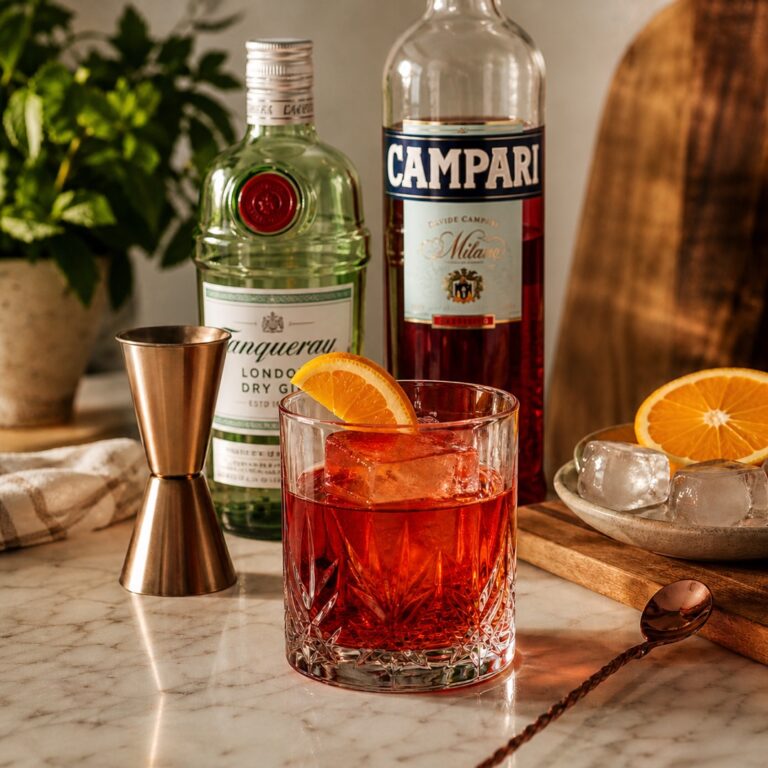
Negroni: a foolproof recipe

Ingredients
- 3 cl gin
- 3 cl Campari
- 3 cl sweet vermouth
- orange peel garnish
Equipment
- vegetable peeler
Instructions
- Measure the ingredients with a jigger.
- Pour all the ingredients into the glass.
- Add two ice cubes and stir with a spoon.
- Fill up with ice cubes.
- Use a vegetable peeler to cut a large piece of orange peel.
- Garnish the glass with the peel.
Notes
Common errors
To make a mess with gin
You only have three ingredients— if one of them isn't up to par, you'll feel it immediately! This is even more important since Campari and vermouth have very distinct flavors; you need to match them head to head. You're not required to spend a fortune on a Monkey 47, but a Tanqueray or a Citadelle would work perfectly well.
Not being curious about the vermouth
For 99% of people, vermouth = Martini. Be curious: in France, we have vermouth brands too (Dolin, Noilly-Prat, etc.). In Italy and Spain, there are dozens and dozens. Experiment!
Use the ice cubes that are already there
Try a simple test: take the ice cubes currently in your freezer. Let them melt, and drink the resulting water. It probably tastes like broccoli. Would you want that in your Negroni?
Do not stir for too long
Water, via Ice (in French)Orgeat is an essential ingredient in cocktails. You must dilute it to at least 30 percent, or even 50 percent, for your cocktail. You therefore need to stir it for at least 30 seconds. I sometimes even stir a cocktail for nearly a minute.
Variations of the Negroni
If you ever get tired of the classic Negroni, know that there are many variations. The most well-known is probably the Negroni Sbagliato (in French), in which you replace the gin with Prosecco. It will appeal to those who enjoy spritzes and Americanos. Speaking of Americanos, don't hesitate to go back in time and try it too.
If you extract the essence of the Negroni, it's actually just a cocktail equal shares, with a spirit, a liqueur and a fortified wine. You can therefore reproduce it quite easily with other ingredients. You can make a White Negroni with a French gin (in French), using Suze instead of Campari, and white Lillet instead of vermouth for a 100% French version, or replacing the gin with tequila for an even more original twist.
Since we're changing the base spirit, for greater roundness and woodiness, explore the side of the Boulevardier, a cocktail very similar, and possibly predating the Negroni (in French)It always features the Campari-vermouth duo, but with bourbon instead of gin. Plus, it's not equal shares, there's a double dose of bourbon, to be handled with care!
The base spirit: gin for the Negroni, and bourbon for the Boulevardier. The bourbon amount is doubled in the Boulevardier!
A variation where gin is replaced with prosecco. Legend has it the bartender mistakenly grabbed the bottle in the dark.
Count 18° to 22° depending on dilution. That's definitely stronger than a glass of wine.
Yes, three times yes. You can prepare your Negroni in a bottle (without ice), and you can even keep the bottle for a long time—this is known as bottle-aged cocktail. And this will soon become the subject of a future article.