Whether it's a cocktail, a rum old-fashioned, or a homemade liqueur, we mix different products with varying alcohol contents. It's hard to visually estimate the final alcohol by volume (ABV) percentage. I'll present two different methods for doing so. At the end of the article, you'll also find an online alcohol content calculator that I coded myself.
The first method requires a calibrated hydrometer for alcohol content. It works very well for spirits, but if your mix contains sugar, you'll need to do a bit of adjustment to correct the reading.
The second request is to do a bit of math and especially to know the exact quantities of your ingredients. Don't worry, I've written a little calculator to help you out.
Calculate the alcohol by volume using a hydrometer
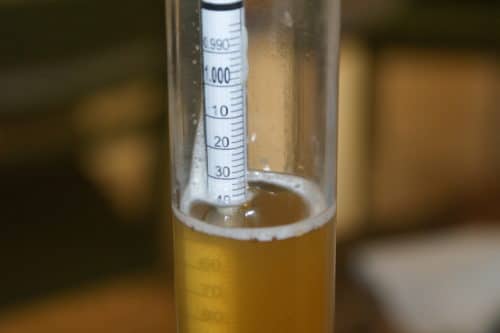
A hydrometer is a very simple device that allows you to measure the amount of water-ethanol mixture by simple reading. You place it in the liquid to be measured, and it is calibrated so that the position of its float indicates the alcohol percentage directly on the device. As shown in the image above.
Hydrometers are often sold in pairs or triples, since the calibration differs across different alcohol concentration ranges. You also need to respect the temperature at which it was calibrated, as temperature affects density (and thus the floating line — you remember, Archimedes' principle, all that...)
The problem is that hydrometers are calibrated for spirits, which contain only water and ethanol. Thus, they won't work for liqueurs, wines, or beers, which contain sugar among other things, altering the mixture's density. Always that damn Archimedes. If you know the sugar content of your mixture (because you prepared it), then you simply need to read the table of specific gravity deviation correspondence by sugar content presented in this article (in French).
If you don't know the sugar concentration, I'm sorry to say, but you'll only get a lower-bound approximation through your hydrometer. That is, the alcohol content will be higher than the hydrometer reading, but you won't know by how much.
Finally, if you know exactly the volume of each ingredient in your preparation, you can save yourself the need to buy a hydrometer by doing a few simple calculations. Don't worry—we'll go slowly.
Alcohol by volume calculation based on ingredient quantities
Following a small thread on a bartender forum, I realized that some people's math classes had been very long ago, and that a quick refresher on percentages and averages would be necessary. I thought this might interest our readers, especially those who associate mathematics with school torture. Yet there's nothing more straightforward than calculating a cocktail's strength. All it takes is mastering the concept of weighted averages. Note that some of the mixtures listed below are for illustrative purposes only and are not officially approved by CocktailMolotov.
You'll thus answer the question « Ce daiquiri (in French) Is it Undrinkable (in French) ? »
Simple example: whisky and soda
Take a simple example: I pour 4 cl of 40° whisky into a glass, then 4 cl of Coca (0°). The resulting drink will clearly have a strength of 20°, since I have equal amounts of whisky and Coca. Indeed, only the whisky contributes alcohol to the mix, the amount of alcohol remains the same, while the volume doubles. The strength is therefore halved.
Second example: equal parts whisky and fortified wine
This time you're taking a risk, and instead of mixing a simple half-and-half Whisky-Coca, you're serving 4 cl of rye whiskey (in French) (40°) and 4 cl of sweet vermouth (15°). The diluent now contains alcohol too. The new mixture has an alcohol content of (40+15)/2 = 27,5°. Since the ingredients are added in equal quantities, a simple average gives the drink’s alcohol content.
Third example: a Manhattan
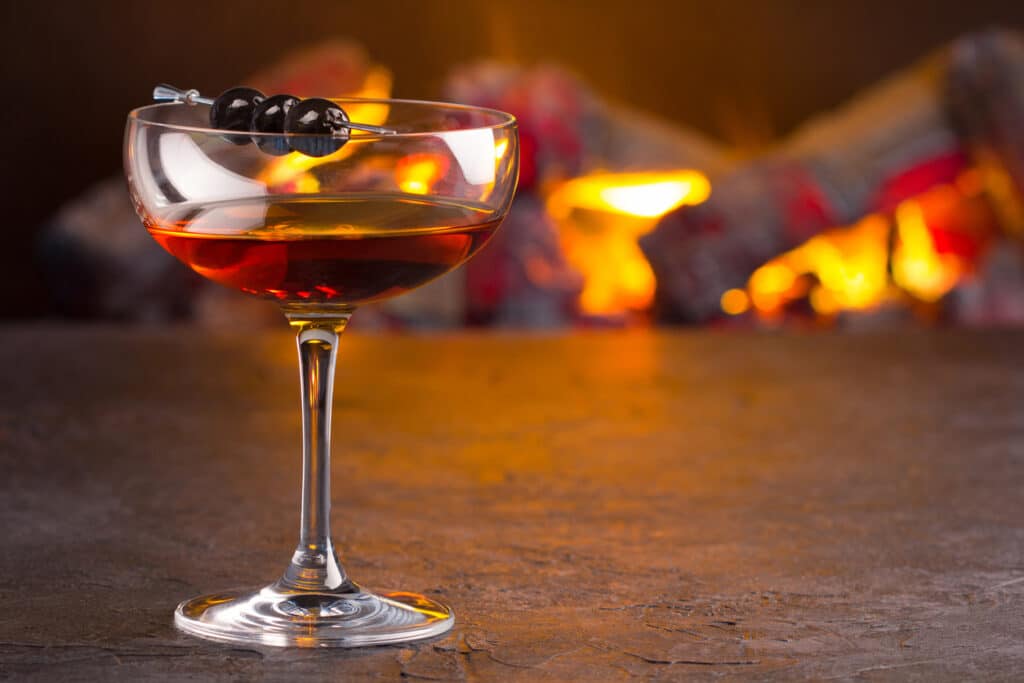
Let's admit you've come across a recipe for a cocktail called « Manhattan (in French)”, you know you need 6 cl of rye to 3 cl of sweet vermouth, rather than 4 and 4. This is where things become more complicated. Since there is more rye than vermouth, its alcohol content has a greater influence on the mixture. How much? The calculation gives the answer: (6×40 + 3×15)/(6+3) = 32°.
Fourth example: three ingredients with different volumes and alcohol strengths
Finally, even more difficult, this time with Burlington (in French). 6 cl of rye (40°), 2.5 cl of Punt e Mes (16°), 1.5 cl of salted maple syrup (0°). This gives a general alcohol content for the cocktail: (6×40 + 2.5×16 + 1.5×0)/(6 + 2.5 + 1.5) = 28°.
Except that this happens when adding the ingredients to the mixing glass. Then you add ice, and thus water! Approximately 30% water is added relative to the initial volume. The final volume is therefore no longer 10 cl, but 13 cl. So the alcohol content becomes (6 x 40 + 2.5 x 16 + 1.5 x 0)/[(6 + 2.5 + 1.5) x 1.3) = 22°. We see that water plays a major role in cocktails, both for temperature (which will be the subject of a future post) and for dilution. These two factors are essential in the perception of a cocktail's taste.
Explanation
The alcohol content is a percentage : it indicates the ratio between the volume of alcohol and the total volume of liquid at 20°C (as volumes can change with temperature, though this will be the subject of another article). For example, in one liter of gin at 40°, there is 1 L x 40% = 40 cl of pure ethanol (the scientific name for the alcohol present in spirits). If I add 1 L of water, the volume of alcohol remains the same, as there is no alcohol in water (to my knowledge), while the total liquid volume is now 2 L. The alcohol content is then 40 cl / 2 L = 20%.
So in the previous small formulas, by multiplying the ABV of the rye by its volume, I get the amount of alcohol from my rye dose. By adding the alcohol content from the vermouth, I obtain the total alcohol amount. Then I divide by the sum of the volumes (increased by 30% due to dilution), and voilà — the new volumetric alcohol strength of my cocktail. Easy, isn't it?
Generalisation
Examples are good, but a formula that works every time is even better.
It is noted that:
N the number of ingredients in the cocktail in question
vi the volume of ingredient i.
ti the alcohol content of ingredient i.
T the final alcohol content of the cocktail.
D The dilution rate related to melting ice
We therefore obtain a fairly simple formula for calculating the alcohol content :
As you can see, the cocktail is often a bit awkward, but we can always find a way to have fun!
The alcohol by volume calculator from CocktailMolotov
For those of you who aren't particularly math-savvy, I've made an online calculator. You just need to enter the alcohol percentage and volume for each ingredient in the cocktail. Press the + to add an ingredient, on the – to remove it.
Ingredient 1
Ingredient 2
Result